• Structured Cost Excellence Program integrates R&D, procurement, manufacturing, and supply chain.
  • Best-cost country sourcing and cost optimization enhance efficiency.
  • Supplier collaboration delivers innovation.
  • Dual focus on cost leadership and customer centricity underpins sustainable competitiveness and growth.

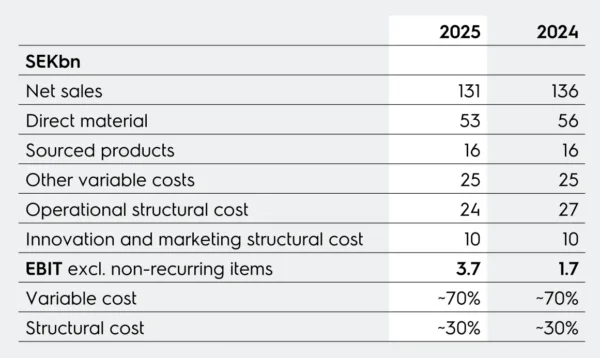
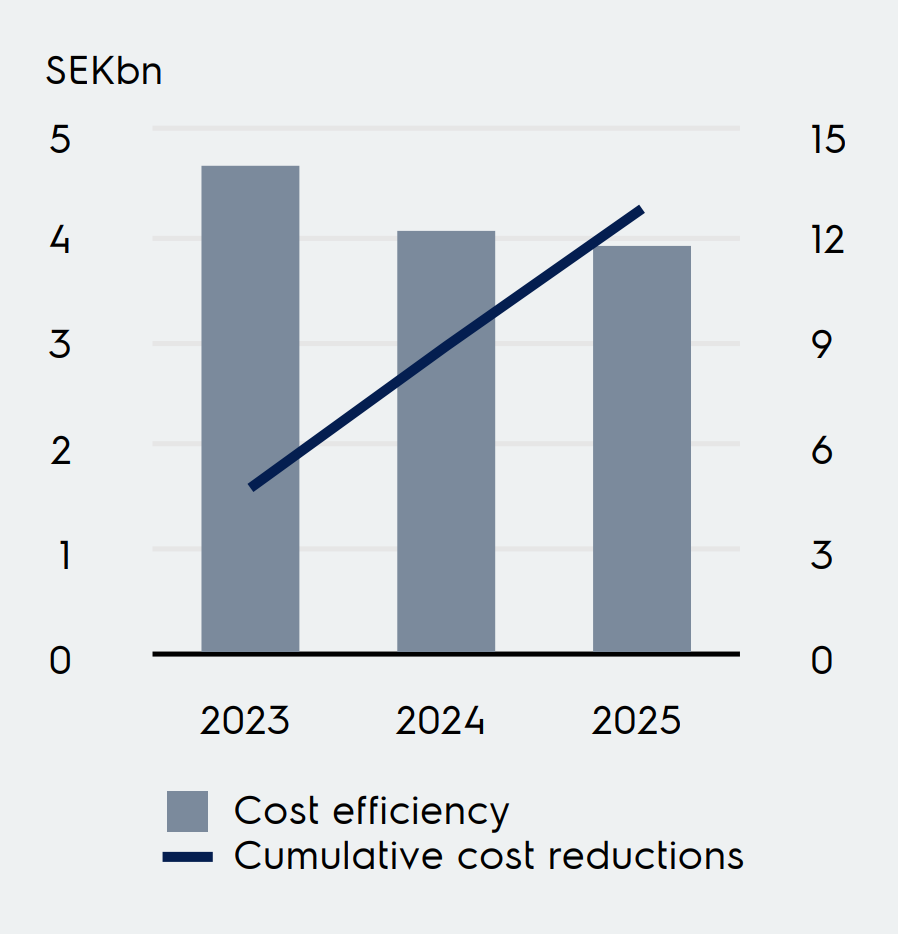
Cost leadership is a fundamental pillar of Electrolux Group’s long‑term competitiveness, profitability, and growth. In 2025, cost reductions of SEK 4bn were delivered, following SEK 4bn in 2024. While previous savings stemmed largely from organizational simplification, focus in 2025, and going forward, centers on product cost reductions, optimized sourcing and industrial efficiency.
 

Sustainability highlights

  • Increasing operational efficiency and reducing waste save costs.
    • Energy efficiency in manufacturing has improved by approximately 50% over the last 20 years, and by 13% in 2025 vs 2020.
    • 99% of the waste from our manufacturing sites are recycled/recovered.
  • Business continuity and brand reputation are protected by responsible sourcing and human rights due diligence.
  • Achieved a strong health and safety performance, reducing cost and benefitting employees.

To ensure continued, long-lasting, cost-reductions, the Group has implemented a structured Cost Excellence Program across R&D, procurement, manufacturing, and supply chain. This program embeds cost management into daily operations and is supported by clear governance, accountability, and capability development. Key enablers include best-cost country sourcing, cost optimization, and supplier collaboration. These measures not only strengthen cost efficiency but also accelerate innovation in common architectures.

Supplier partnerships remain central to this approach, enabling both cost competitiveness and innovation leadership. By leveraging supplier ecosystems, Electrolux Group is able to
introduce consumer-relevant products ahead of competitors while maintaining quality and affordability. At the same time, value engineering initiatives ensure that product specifications and consumer expectations are met while driving cost competitiveness.

The program has fostered a strong cross-functional culture, embedding cost leadership across the organization. Supported by global manufacturing footprints, including presence in China and Thailand, Electrolux Group can optimize product flows and leverage economies of scale. Together, these initiatives provide a resilient and robust platform for sustainable competitiveness, ensuring that cost leadership remains deeply integrated into the Group’s operations and continues to underpin future growth.

Importantly, Electrolux Group couples this structured approach to cost with a consumer-centric strategy, ensuring that both efficiency and consumer focus remain central to driving long-term competitiveness and sustainable value creation. In 2025, it was decided to change the organization, with the introduction of the commercially focused Region Asia-Pacific from January 1, 2026. This is a step in getting closer to the end consumers in Asia to be able to better serve and support the consumers in this region going forward.

Continued significant cost reductions on improving cost base

Focus on cost efficiency is 
integrated in all aspects of the 
company and is a key pillar of 
Electrolux Group’s strategy to 
drive long-term growth and 
profitability. Cost efficiency has
yielded significant savings and
the cumulative positive effect on
operating income from
2023 through 2025 amounted to
SEK 12.8bn.

Cost reductions in 2023 
were largely derived from a 
streamlining of the organization
and headcount reductions coupled
with cost reductions in key areas
such as logistics and production efficiency. In 2024, a simplified organization was launched, and in addition to headcount reductions, focus on cost reductions shifted to product costs, in particular procurement and best-cost country sourcing. In 2025, product cost reductions were accelerated, and on top of sourcing related savings, positive effects from value engineering increased. Looking ahead, best-cost country sourcing, supplier consolidation, value engineering as well as more efficient use of the Group’s manufacturing footprint are expected to remain key drivers for cost efficiency.

Electrolux Group takes further steps to reduce complexity – getting closer to consumers and improving cost competitiveness

Rapid transformation in the home appliance industry is expected to continue at a high pace requiring Electrolux Group to effectively execute on its strategic priorities. Agility and speed are key enablers for the Group to achieve its targets. With changes to the leadership team and organization, Electrolux Group is taking further steps to getting closer to its customers and consumers, reducing complexity and improving cost competitiveness.

Electrolux Group on January 30, 2026, announced a new Product organization. Michelle Shi-Verdaasdonk, Chief Procurement Officer since December 2024, will lead the new Product organization, which will be responsible for product strategy, R&D, Design, Electronics, Connectivity and Procurement. The Product organization will have the mandate and complete responsibility to define the tech and product road map, develop an attractive product ecosystem, and control cost and complexity. The Technology, Digital and Sustainability (TDS) organization will be integrated to the Product organization. The current global product lines Taste and Care will cease, and management of the product categories will be integrated into the Product organization. Product Line Wellbeing & SDA remains a strategic focus area.

“We need to be closer to our consumers,” said Yannick Fierling, President & CEO, “and these changes will help us do just that. The new Product organizational area will bring a sharper, simpler structure with faster decision-making thanks to clear end-to-end accountability, and the regional product teams will be empowered in their work close to the consumers through end-to-end responsibility for commercialization.”