

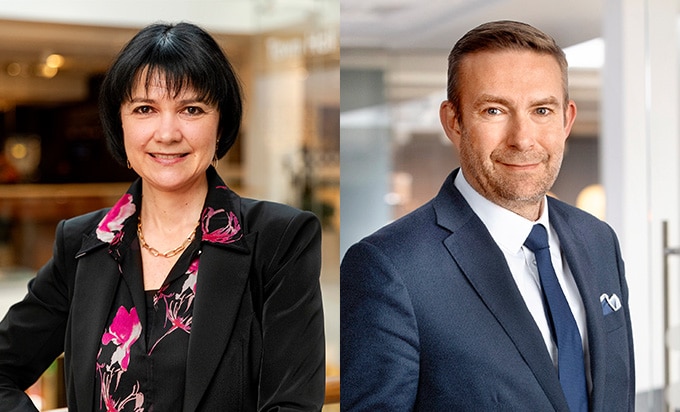
2025 was a breakthrough year for our climate journey as we cut Scope 1 and 2 carbon emissions (in operations) by 45%, and Scope 3 emissions (in products) by 33% compared to our 2021 baseline. Discover how we achieved this — and what’s next — in this interview with CEO Yannick Fierling and SVP Product Strategy, Innovation, Sustainability Elena Breda.
Q. How is sustainability embedded in Electrolux Group’s strategy?
Yannick: Sustainability has long been a cornerstone of Electrolux Group’s strategy. It is a fundamental enabler of our purpose, Shape living for the better, to reinvent lifetime taste, care, and wellbeing experiences for more enjoyable and sustainable living around the world.
Our focus on sustainability also enables us to deliver outstanding lifetime experiences with solutions that always get better. Our sustainability leadership is here to stay: it’s who we are, and we work very hard to continue to be a sustainability leader in our industry and beyond.
Q: What are the key recognitions Electrolux Group has achieved for its sustainability initiatives?
Yannick: The Group was awarded an A score in CDP’s Climate Leadership rating, placing it once again among the top four percent of companies globally assessed for climate transparency and action.
This recognition acknowledges the Group’s continued progress toward its science-based targets for 2030 and its ambition to achieve net-zero carbon emissions by 2050. The Group achieved its first science-based carbon reduction targets (SBTi) in 2022, three years ahead of schedule.
In addition, the Group achieved two major sustainability milestones: 25 consecutive years of participation in the S&P Global Corporate Sustainability Assessment (CSA) and inclusion in the S&P Global Sustainability Yearbook 2026. Developed by S&P Global, the CSA underpins the Dow Jones Sustainability Indices and is one of the world’s leading ESG (environmental, social and governance) performance frameworks, widely used by investors globally.
Q. What were the most significant climate achievements in 2025?
Elena: 2025 marked a strong year of progress on climate action. We reduced Scope 1 and 2 carbon emissions by 45% compared to our 2021 baseline, while Scope 3 emissions declined by 33% over the same period. We met the Science Based Target initiative’s (SBTi’s) 10-year target criteria in just four years. These results reflect years of focused investments in energy efficiency, renewable energy, and supplier engagement, and demonstrate that our science-based targets are translating into real-world impact across our value chain.
Renewable energy has been a critical enabler, and we can report that 97% of the electricity used in our operations and 67% of total energy consumption came from renewable sources in 2025. This shift has significantly reduced our operational carbon footprint and strengthened the resilience of our manufacturing footprint as energy systems continue to decarbonize globally.
Q. Product innovation is often highlighted as a key lever for sustainability. What progress did you make in this area?
Yannick: Resource-efficient products continue to be central to our strategy. In 2025, our most energy and water efficient products accounted for 26% of total units sold and 36% of gross profit, demonstrating that sustainability and business performance go hand in hand. By designing appliances that consume less energy, water, and materials, we help consumers reduce their environmental impact while delivering strong commercial results.
Q. Circularity is another key pillar ofthe Group’s sustainability strategy. What were the main achievements in 2025?
Elena: We made strong progress toward a more circular business model. Recycled steel and plastic accounted for 23% of the materials used in our manufactured products, and we recycled or recovered over 99% of manufacturing waste. In addition, we raised our average Repairability Index to 8.5 out of 10, marking the third consecutive annual increase and reinforcing our commitment to extending product lifetime.
Q. How does Electrolux Group ensure a safe and responsible working environment across its operations?
Yannick: Health, safety, and human rights are non-negotiable priorities. In 2025, we achieved a Total Case Incident Rate of 0.33, reflecting a strong safety culture across the organization. We also reached 100% ISO 45001 certification across all finished goods manufacturing sites and conducted Human Rights Impact Assessments to identify and address risks. We audited 30 out of our 32 factories for fulfilment of our Workplace Policy.
Q. Supplier engagement plays a major role in ESG performance. How did you work with suppliers in 2025?
Elena: We continued to deepen engagement across our supply chain. Eighty-six suppliers participated in trainings in Mexico, Brazil, Thailand, and Egypt. We conducted over 400 supplier audits, including around 5,400 confidential worker interviews. This level of engagement allows us to gain deeper insight into workplace conditions and drive continuous improvement.
We are honored to have been named Supplier Engagement Leader by CDP for the work we have done with our most strategic suppliers to drive transparency on climate and water in the supply chain.
Q. How does Electrolux Group ensure the safe and responsible use of materials and chemicals?
Yannick: Responsible materials management is essential for product safety, environmental protection, and regulatory compliance.
In 2025, we updated our Restricted Material List to reflect the latest scientific research and regulatory developments. We also tested 3,500 components for chemical compliance and requested detailed information on regulated substances from 470 suppliers. This systematic approach helps us mitigate risk and ensures transparency across our supply chain.
Q. Water stewardship is becoming increasingly important. What progress did the Group make in 2025?
Elena: Water efficiency remains a key focus, particularly in areas facing higher water risk. Since 2020, we have improved manufacturing water efficiency by 24% in potential risk areas and by 7% in other locations worldwide. Our efforts were recognized through the achievement of CDP Water Security Leadership level (A-), highlighting both our performance and transparency on water-related issues.
Q. Biodiversity is a growing focus insustainability discussions. How is Electrolux Group addressing this area?
Elena: In 2025, we took important foundational steps. We completed the Group’s first assessment of potential biodiversity loss across the value chain. This assessment helps us better understand where our impacts and dependencies lie, enabling more targeted actions going forward.
Q. The Electrolux Food Foundation has reached a major milestone ahead of schedule. Can you tell us more about this achievement and what made it possible?
Yannick: We are proud that the Electrolux Food Foundation has reached one of its 2030 goals five years early, having now educated 300,000 children on sustainable eating. This milestone reflects the strong engagement and commitment of our people and partners.
Since 2018, thousands of Food Heroes workshops have been delivered across our offices, factories, and external venues such as schools and by non-governmental organizations. This progress would not have been possible without the support of our partners, including Worldchefs, AIESEC, and Cook School. Building on this success, the Foundation has now set an even more ambitious goal: to reach one million children by 2030.
Q. Looking ahead, what doour 2025 sustainability results mean for Electrolux Group’s sustainability journey?
Yannick: The 2025 results show that our strategy is delivering measurable impact for people, planet and the business. This is an important card we can play in establishing ourselves as a challenger.
These results highlight the good progress and where we need to go further, particularly on circular product design. Sustainability remains a fundamental enabler of our strategy, and we will continue to integrate it deeply into how we innovate, operate, and grow the business in 2026 and beyond.