

Electrolux Group aims to contribute to a more circular economy by focusing on product durability, services and materials.
Circularity is part of the Group’s For the Better sustainability framework. The approach focuses on using resources more efficiently, reducing waste and keeping products, components and materials in use for longer.
The Group works to integrate circularity considerations across the value chain—from product design and material sourcing to manufacturing, product use and end of life. Initiatives include increasing the use of recycled materials, improving product reliability, enabling repair and refurbishment, and exploring circular business models in collaboration with value chain partners. Read more about our progress here.
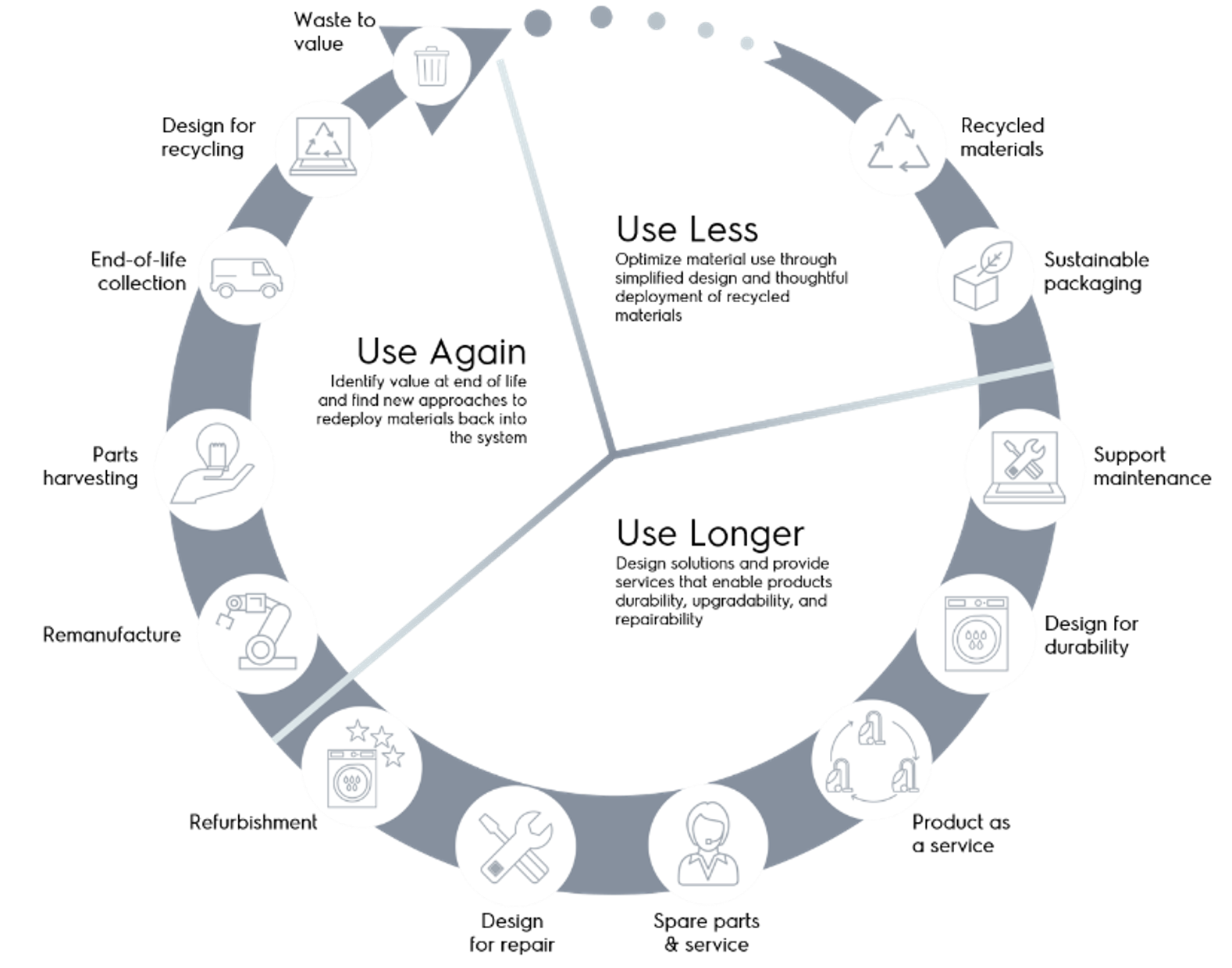
Use Less, Use Longer, Use Again
Electrolux Group’s approach to circularity is based on three fundamental principles:
- The Use Less principle refers to the Group’s efforts to optimize material use through design and deployment of recycled materials in products and packaging.
- The Use Longer principle refers to the Group’s efforts to design solutions and services that can enable the durability, upgradability and repairability of its products.
- The Use Again principle refers to the Group’s efforts to find value at the product’s end-of-life by redeploying materials, components and products.
Value for resourcefulness
Circularity in the European Union (EU)
In the last decade, circularity has become a key focus in the European Union (EU), where the Ecodesign for Energy Using Products Directive 2009/125/EC is gradually being replaced by product-specific requirements under the Ecodesign for Sustainable Products Regulation (ESPR) (EU) 2024/1781, which entered into force in July 2024. ESPR expands the existing eco-design requirements beyond energy-related products to address circular economy performance across the entire lifecycle.
ESPR’s objectives closely reflect Electrolux Group’s circularity strategy which aims to reduce resource use, extend product longevity and promote reuse throughout the product lifecycle.
Striving to use less resources:
Electrolux Group started proactively to address these aspects many years ago. For example, in Europe, the first initiative on recycled plastics started already in 2010, when it launched the “Vac from the Sea” campaign, creating five vacuum cleaner prototypes featuring plastics collected from the ocean. The project aimed to raise awareness on plastic waste and was paired with the launch of a commercial range of vacuum cleaners including recycled plastics. Later, the Group introduced recycled plastics into major appliances, further leveraging material innovation, including the development of new materials formulations including Carborec.
In 2023 the Group launched the World’s first fridge with 70% recycled plastic inner liners. Inner liners are the internal side walls of the fridge that can be seen when opening the door. Electrolux Group was the first appliance manufacturer in the world to incorporate this amount of recycled plastic into a refrigerator securing a European Plastics Recycling Award.
Building on relationships with innovation partners across the value chain, Electrolux Group participated in various EU-funded projects including PLAST2bCLEANED to recycle WEEE plastics (more info at https://plast2bcleaned.eu/) and circular foam to upcycle rigid polyurethane (PU) foam used in refrigerator insulation.
The Group is also committed to increasing the use of recycled steel scrap through Electric Arc Furnace (EAF) steel in place of traditional Basic Oxygen Furnace (BOF) steel. EAF steel has already been integrated into selected product categories, and we are actively working to extend its adoption across additional product lines. At the same time, we continue to optimize material usage while consistently maintaining the functional performance, durability, and quality standards expected from our products.
Having had a forward-looking perspective for many years, Electrolux Group has also been actively contributing to EU policy discussions to develop a policy framework conducive to innovation and investment in material circularity. Furthermore, the Group participates in standardization committees on material efficiency and related circularity topics.
Striving to use resources for longer
Electrolux Group strives to design durable products that meet consumers’ lifetime expectations and that can be easier to repair as required by EU legislation. The Group also strives to improve resource efficiency and key component accessibility. This includes making spare parts available for a defined period after products are placed on the market, enabling repairs using commonly available tools and supporting both professional repairers and, where appropriate, consumers. Compliance with the EU ESPR and Right to Repair legislation (Directive 2024/1799 on the Repair of Goods) can help reduce the environmental impact of products across their lifecycle. **
The Group has developed a Design for Repair Guideline aimed at supporting designers during the early stage of product development across product lines. The Group designs appliances with batteries that can be easily replaced by consumers, for instance in vacuum cleaners and remote controls. Complying with the EU Battery Regulation (EU) 2023/1542, the Group strives to support product longevity and resource efficiency.
Note** Electrolux Group strives to enable self-repair and access to spare parts in accordance with the EU Ecodesign and Right to Repair frameworks. Spare parts are available to order in our spare parts web shop. Complying with the EU General Product Safety Regulation, certain spare parts for products are available only to professional repairers.
Under Article 24 of the ESPR and the Commission Implementing Regulation (EU) 2026/2, Electrolux Group is required to annually disclose the amount of discarded unsold goods. This can, for example, cover products that are damaged during transport and beyond repair. Our disclosure on Discarded Unsold Goods for the financial year 2025 (January–December) will be available by the end of 2026.
Striving to use resources again
The Group has taken part in setting up compliance schemes for handling the takeback and recycling of discarded appliances in all European countries in line with the Waste Electrical and Electronic Equipment (WEEE) Directive 2012/19/EU.
The EU WEEE Directive is an EU-wide framework which stipulates that the collection, treatment, recovery and environmentally sound disposal of electrical and electronic products must be handled and financed by the producer or importer.
The Directive sets minimum recovery and recycling targets for different categories of equipment. For large household appliances, it requires that at least 85% of the average weight per appliance must be recovered, of which at least 80% must be prepared for reuse or recycled. For small household appliances, at least 75% must be recovered, of which at least 55% must be prepared for reuse or recycled. The remaining share may be recovered through other processes, including energy recovery.
To comply with Extended Producer Responsibility (EPR) requirements, Electrolux Group participates in takeback schemes in the EU member states.
For example, in 2002, Electrolux Group, alongside Braun, Hewlett Packard and Sony founded the European Recycling Platform (ERP) with the objective of providing a cost-efficient and competitive pan-European compliance scheme. In 2014, the founding members sold the platform to Landbell Group.
In European countries where Electrolux Group is not using the ERP for WEEE management, the Group works through national compliance schemes, often created by the national industry associations.
Besides WEEE, Electrolux Group also takes part in EPR schemes for batteries and packaging as legally required. The Group fulfils its obligations through Producer Responsibility Organizations (PROs), reporting volumes placed on the market, and contributing toward the achievement of EU recycling and recovery targets.
Information about the treatment facilities used to handle the discarded products, according to Article 15 of Directive 2012/19/EU on Waste Electrical and Electronic Equipment (WEEE), is available at About – I4R Platform.