

The Group’s global presence, with manufacturing and sales in many countries, creates currency exposure but also offsets exchange rate effects to a certain degree.
The principal exchange rate effect arises from transaction flows, when purchasing and/or production is carried out in one currency and sales occur in another currency. Every month Group Treasury collects forecasts of the transaction flows for the coming 12 months from the operating units and hedges the invoiced flows. To some extent, the Group also utilizes currency derivatives to hedge forecasted flows with both committed price and volumes. The results from the currency hedges are transferred to the operating units. It is the business areas’ responsibility to manage the FX risk of the forecasted flows through immediate price adjustments and cost reductions.
Electrolux is also affected by translation effects when the Group’s sales and costs are translated into SEK. The translation exposure is primarily related to currencies in those regions where the Group’s most substantial operations exist.
Main transaction flows
The main transaction flows and currency pairs are presented in the map together with an explanation of how they impact the Group.
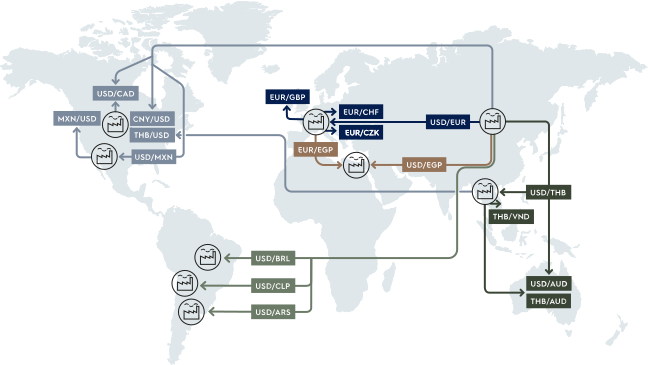
North America
Electrolux is a net importer into the market with flows mainly from China, Thailand and production conducted in Mexico. In addition to this, the operation in Canada has an exposure to USD as Electrolux imports products into that market.
Latin America
Most of the finished products originate from own factories in the region, while imported input goods such as raw materials and components are largely denominated in USD.
EMEA
A major part of the currency flows in Europe is denominated in EUR, with external imports primarily in USD. Electrolux faces currency exposure when the cost base in the factories differs from the domestic sales.
China
The Group sources a large volume of input goods and finished goods from China to Electrolux globally. A major part of these is invoiced in USD but also in CNY.
Australia
Import flows are based in USD from external suppliers and in THB from the Electrolux facility in Thailand.
Sensitivity analysis of currencies
The major currencies for the Electrolux Group are the USD, EUR, BRL, CAD, AUD, THB, CHF, GBP, MXN and CZK. In general, income for Electrolux benefits from a weak USD, EUR, THB and MXN and from a strong BRL, CAD, CHF, GBP, AUD and CZK. In countries with large manufacturing and logistics centers, effects over time will to a large extent balance out due to natural hedging.
| Sensitivity analysis year-end 2025 | ||
| Risk | Change | Pre-tax earnings impact, SEKm |
| Currency and interest rates | ||
| Transactional exposure USD to BRL | 10% | 410 |
| Transactional exposure USD to EUR | 10% | 350 |
| Transactional exposure USD to CAD | 10% | 330 |
| Transactional exposure EUR to CHF | 10% | 320 |
| Transactional exposure EUR to GBP | 10% | 220 |
| Transactional exposure MXN to USD | 10% | 190 |
| Transactional exposure THB to USD | 10% | 140 |
| Transactional exposure THB to AUD | 10% | 130 |
| Transactional exposure USD to AUD | 10% | 100 |
| Transactional exposure EUR to CZK | 10% | 100 |
| Translation exposure to SEK* | 10% | 396 |
| Interest rate | 1 percentage | 10 |
| * Assuming the Swedish krona appreciates/depreciates against all other currencies | ||