


The Group’s ambitious Climate Goals focus on its key impacts — aiming to reduce its greenhouse gas emissions.
Electrolux Group’s long-term ambition is to ensure that its entire value chain is net zero by 2050. This supports the UN Global Compact — Science Based Targets initiative’s Business Ambition for 1.5°C campaign.
Electrolux Group achieved its 2025 science-based climate target to reduce 80% of absolute emissions in its operations (scope 1 and 2) and to reduce emissions by 25% in the use phase of sold products (scope 3) with 2015 as the baseline year, three years ahead of plan in 2022.
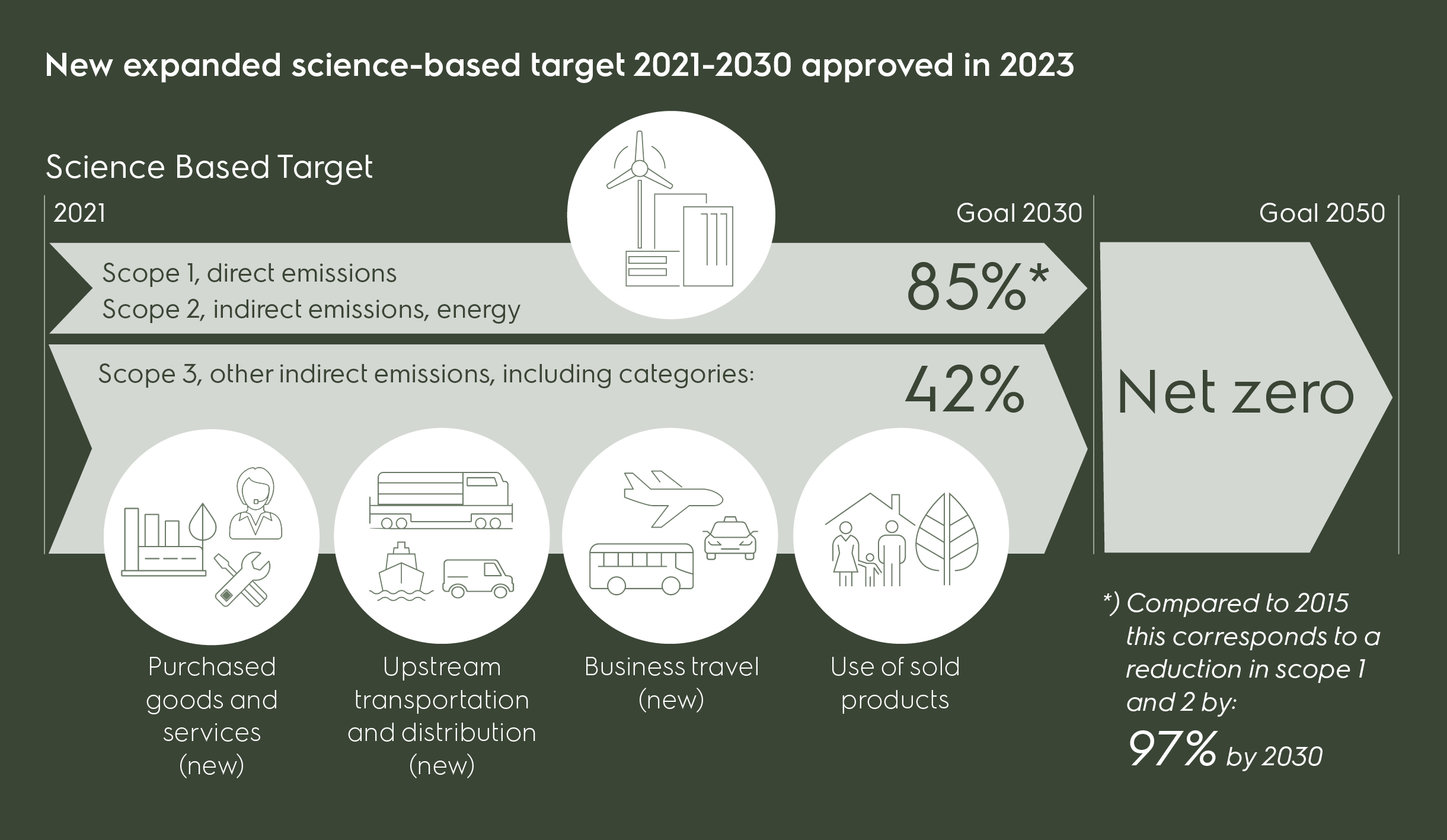
The Group got its second science-based target approved in 2023. This target aims to reduce the emissions from its operations (scope 1 and 2) by 85% and the absolute scope 3 emissions by 42% between 2021 and 2030. In 2023, scope 3 emissions were broadened from the use of sold products to also include materials, transport of products and business travel.
The target is aligned with the 2015 Paris climate agreement, which aims to keep the global temperature rise in line with a 1.5°C trajectory to avoid the most severe impacts from climate change.
Electrolux Group’s Scope 1 and 2 emissions were ~100k metric tons CO₂e, and Scope 3 emissions in the target categories totaled ~39,500k metric tons CO₂e in 2021.
Read here about the latest achievements on emissions reduction >>
Climate Transition Action Plan (CTAP)
Electrolux Group recognizes the role its business can play in supporting the transition to a lower-carbon economy. The Climate Transition Action Plan (CTAP) sets out near-term actions and time-bound strategies intended to support the Group’s climate-related objectives. The plan describes the steps Electrolux Group is taking to address climate-related impacts across its operations and value chain, in line with applicable reporting requirements and supported by measurable targets, governance and follow-up.
Through the CTAP, Electrolux Group aims to reduce the climate impact associated with its activities and products, while continuing to offer taste, care and well-being experiences that support lower-impact choices for consumers, where these benefits are substantiated by relevant data.
(PDF) Climate Transition Action Plan 2026 >>
The case for action
Tackling climate change by reducing greenhouse gas emissions is one of the most urgent challenges facing society. According to the latest Intergovernmental Panel on Climate Change (IPCC) Report (Climate Change 2023: Synthesis Report), human activity is already changing the climate in unprecedented ways. The report calls for strong and sustained action to limit climate change.
As product energy use contributes the most to the Group’s global climate impact — 85% of the 2021 emissions — this is where the company can make the greatest contribution to tackling climate change.
Electrolux Group is reducing carbon dioxide emissions from its own manufacturing facilities as well as from transportation, materials used in products and business travel. In addition, the Group strives to make a difference by eliminating the use of hydrofluorocarbons (HFCs) in refrigerators, air conditioners, and technical barriers to using alternative solutions.
What are Scope 1, 2 and 3 emissions?
The Group uses the definitions in line with the GHG Protocol:
Scope 1: Emissions produced directly by an organization, for instance through the combustion of fuels, e.g. natural gas combustion for heating.
Scope 2: Includes indirect emissions generated through the consumption of purchased energy, e.g. through electricity use.
Scope 3: Other indirect emissions due to the activities of an organization, but that are produced and controlled by a different emitter, e.g. emissions resulting from the use of a company’s products.
Sources:
1) Intergovernmental Panel on Climate Change (IPCC). www.ipcc.ch/report/sixth-assessment-report-cycle/
2) Based on global Electrolux Group lifecycle assessment data.
3) Better Living Report 2019