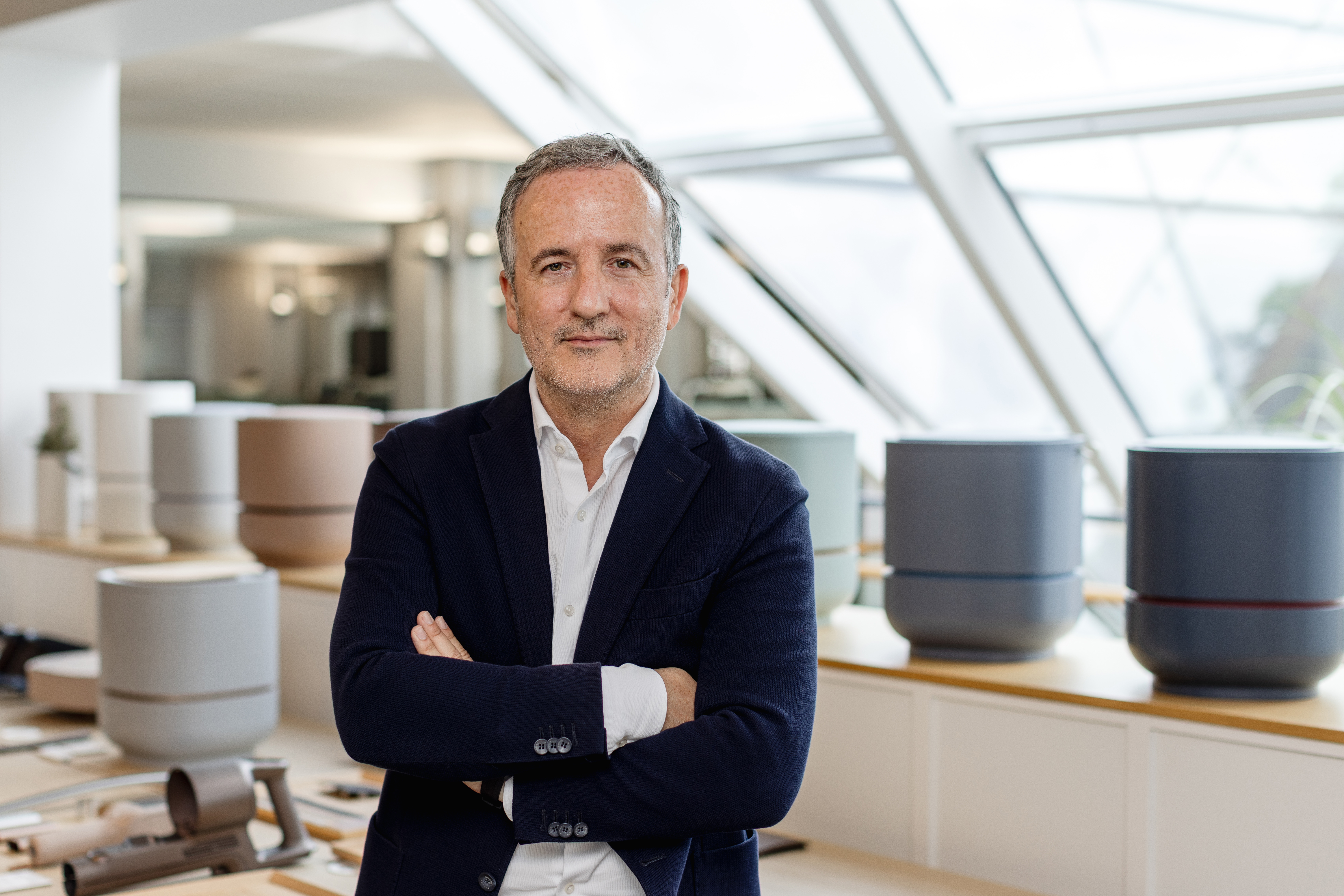
Joaquín García Sanchis joined Electrolux Group as Head of Global Design in March. In this interview, he shares what beautiful design means to him and the important role design plays in setting ourselves up to become challengers in the industry.
Joaquín, almost 20 years of your career has been in the automotive industry. Can you tell us more about your background?
I studied industrial design and then specialized in car design at the Royal College of Art in London. After that, I worked for several major automotive brands in Europe, as well as on industrial and product design projects, before joining Electrolux Group in March.
In the automotive industry, there is a strong focus on building strong brands, and design plays a strategic role in this as one of the key contributors to building up brand awareness, differentiation and value. I see many similarities with Electrolux Group, as brand awareness and the consumer experience are very important in both industries.
I’m looking forward to bringing my experience from the automotive industry to Electrolux Group to help strengthen and shape our brands through design-led thinking and consumer-focused innovation.
What does beautiful design mean to you, personally?
In the automotive world, we used to say that when you see a new car pass by, you turn your head and follow it with your eyes. There’s a moment where you fall in love, just like with human interaction.
When you build a relationship with that person, you get to know them more deeply. So, there’s the first impression and then the long-term relationship. In car design, we studied this balance between the first impression and long-term relationship very closely.
Overall, good design to me is uncomplicated. A product can be complex but its design should be timeless and sustainable. Built to last.
How has the role of design evolved over the last two decades?
Up until 15 years ago, design was very aesthetic. It was all about appearance. This changed with the acceleration of the touchscreen user interface, driven by Apple.
The Asians have been the biggest disruptor in the past five years across all industries, I believe. They have good design, with the Koreans and Japanese leading in terms of simplicity. When it comes to speed, value, adapting new ways of working, Chinese companies have been a wake-up call for the Western world, helping us to grow and improve.
You’re joining Electrolux Group at an exciting moment as we set ourselves up to become challengers in our industry. How can we make our brands stand out and adapt to increasingly competitive global markets?
One of them is identity. Identity is the most important thing for a brand. We have a very strong identity that we need to protect. But not by fencing it in and closing it off to other influences and expansion. On the contrary, we need to evolve our brands, Scandinavian origins, our values and our way of doing things over time. I’m not saying we need to forget this, but we need to adapt to the future, especially when it comes to speed and decision making.
Then, there is heritage. This is the only thing we have that our Asian competitors don’t. They have everything else – people, talent, cash to invest, knowledge, expertise and industry – but, at the most, they only have a few decades of heritage. Electrolux Group has over 100 years of history and that is something we can be proud of and leverage.
Finally, there is the mindset. The market pressure and the increasing sense of urgency is real but we cannot allow it to paralyze us. Instead, we need to channel that urgency into action, approach our work with confidence and believe that we can succeed.
What roles do sustainability and circular design play in the future of product design?
Sustainability is strongly connected to our Scandinavian heritage, values and culture.
A core pillar in our sustainability strategy is building products that last and that are repairable and promoting a circular business model. This is the future of product design with a focus on consumer behavior.
What is your favorite design period?
I think the 1950s, 1960s and 1970s were my favorite decades in the history of design. Back then, technology was important but there was more emphasis on innovation, materials, physical interaction, character, etc.
Finally, tell us something about yourself that might surprise your new colleagues.
I’m not sure if this will surprise people but I am definitely not the stereotypical designer, who is always on top of the latest trend wave. People are often surprised by how down-to-earth I am as a person, and I’m not into fancy things either.